


Hotdropping is overrated in high-ranked Apex, it wins fights but loses games.
If you want rank points, rotations matter more than kills.
This guide gives clear rotation paths and a hotdrop checklist pro players actually use.
You’ll learn when to contest and when to bail.
You’ll also learn which off-angle routes to take and how team comp flips the call.
Follow these rules and you’ll lock down better ring position, cleaner loot runs, and fewer third-party deaths.
High-Level Competitive Landing Strategy and Early-Rotation Philosophy

The 2025 ranked meta rewards smart loot runs over reckless fighting. Top players judge landing zones by loot density per second, who can see what, and how likely the ring pulls their way. Hot zones like Lava Siphon on World’s Edge, Zeus Station on Storm Point, and Promenade on Broken Moon offer great loot but pull two or three squads every time. Safer spots (northeast Storm Point camps, World’s Edge tunnels, Broken Moon’s outer high-ground POIs) give you slower loot but better ring position and way less fighting on drop. The best squads treat the first 60 seconds as recon. They watch the dropship angle, track squad trails, and figure out which POIs won’t be contested before they actually commit to landing.
Whether you contest or bail early depends on five things you can see right now: your team comp (mobility legends let you fight early, anchors need safer drops), how many squad trails you see heading to your POI, ring prediction patterns (pro teams guess first ring based on the ~2:00 timer), how much gunfire you’re already hearing, and whether your squad actually wins early brawls. When two or more squads land at the same POI, whoever grabs high ground or finds a gun first usually wins. But if you land and hear three separate fights overhead, rotating to a nearby empty zone for 20 seconds of clean looting beats joining a chaotic four-way mess.
High-level squads run a strict first 90-second routine: land, grab a weapon and at least white armor within 10 seconds, ping good items for your team, scan for threats, and decide by the 60-second mark whether you’re holding the POI, pushing isolated enemies nearby, or bailing to the next spot. That window isn’t flexible. Sticking around past 90 seconds without a clear edge invites third parties who’ve already finished looting and are hunting kills. You want max loot quality in minimum time with manageable risk, not max loot total.
6 Decision Factors Top Players Use When Choosing Between Hot Drop and Off-Drop Rotations:
- Dropship angle and visible squad count: if four or more squads dive toward your target POI, abort and take the next closest uncontested zone
- Team composition: mobility legends (Valkyrie, Pathfinder, Horizon) let you fight early and escape fast. Anchor legends (Caustic, Wattson, Gibraltar) need safer starts
- Ring prediction: first ring shows up around 2:00. If your POI sits outside the likely pull, grab loot fast instead of extending fights
- Loot density per building: POIs with six-plus loot bins and guaranteed weapon spawns (Storm Point’s Command Center, World’s Edge’s Monument) justify contests. Sparse POIs don’t
- Exit route count: POIs with three or more rotation paths (gravity cannons, ziplines, doors, balloons) are safer to contest than dead ends like Barometer or Antenna
- Squad skill confidence: if your team consistently wins early 3v3s, contesting high-loot POIs speeds up your power curve. If not, rotating early keeps you alive and lets you farm uncontested loot nodes
Mid-Game Rotation Structures and Route Timing

Mid-game rotations run on second ring closure timing, which hits around 3:20 on most maps. The window between first ring close (~2:30) and second ring close is your main rotation phase. Competitive teams treat that 50-second window like it’s sacred. They finish looting, break off from pointless fights, and move toward next ring power positions before the second ring starts shrinking. Waiting until the ring’s actively closing forces you into predictable, choke-heavy lanes where better-positioned teams farm easy kills. The best rotations happen 20 to 40 seconds before the ring moves, when most squads are still looting or fighting and rotation paths are wide open.
Choke-point evaluation separates Diamond players from Master-plus. Every map’s got four to six natural funnels where terrain, buildings, or ring geometry push multiple squads through narrow corridors. Storm Point’s Barometer bridge, World’s Edge’s tunnel systems, and Broken Moon’s Phase Driver chokes are textbook examples. Top teams either claim these chokes early (arriving first and holding angles) or skip them entirely using off-meta routes: tridents, gravity cannons, Valkyrie skyward rotations, or just walking the long way around high-ground edges. Simple rule: if a choke looks contested or you hear gunfire near it, add 30 seconds to your route and go around. Trading 30 seconds for a clean rotate beats losing 60 seconds in a three-way fight that ends with a fourth party mopping up.
Third-party probability spikes in contested zones and goes up with every gunfight that drags past 45 seconds. If you start a fight mid-rotation, you’ve got roughly 30 to 45 seconds to secure kills, loot boxes, and reposition before the next squad shows up. Most players underestimate how fast sound travels and how aggressively good teams push toward gunfire. When you hear a fight, assume at least one other squad heard it too and is rotating that direction. Use that assumption to time your own third party. Land five to 10 seconds after the fight peaks, clean up weak squads, then rotate again immediately before the fourth party arrives.
5 Common Mid-Game Rotation Mistakes to Avoid:
- Rotating too late: waiting until the ring’s moving forces you into crowded, predictable lanes and costs you first-pick power positions
- Over-committing to bad fights: any fight lasting longer than 45 seconds mid-rotation is a mistake unless you’re already in a power position
- Ignoring sound cues: failing to listen for nearby gunfire, ability usage, or footsteps leads to walking into multi-squad zones blind
- Taking the obvious path: if a choke looks like the fastest route, three other squads are thinking the same thing. Use off-angles and longer safe routes instead
- Not checking ring pull: failing to scan the next ring before rotating leads to wasted movement toward zones that’ll be outside the next circle
End-Game Ring Control and Positioning Theory
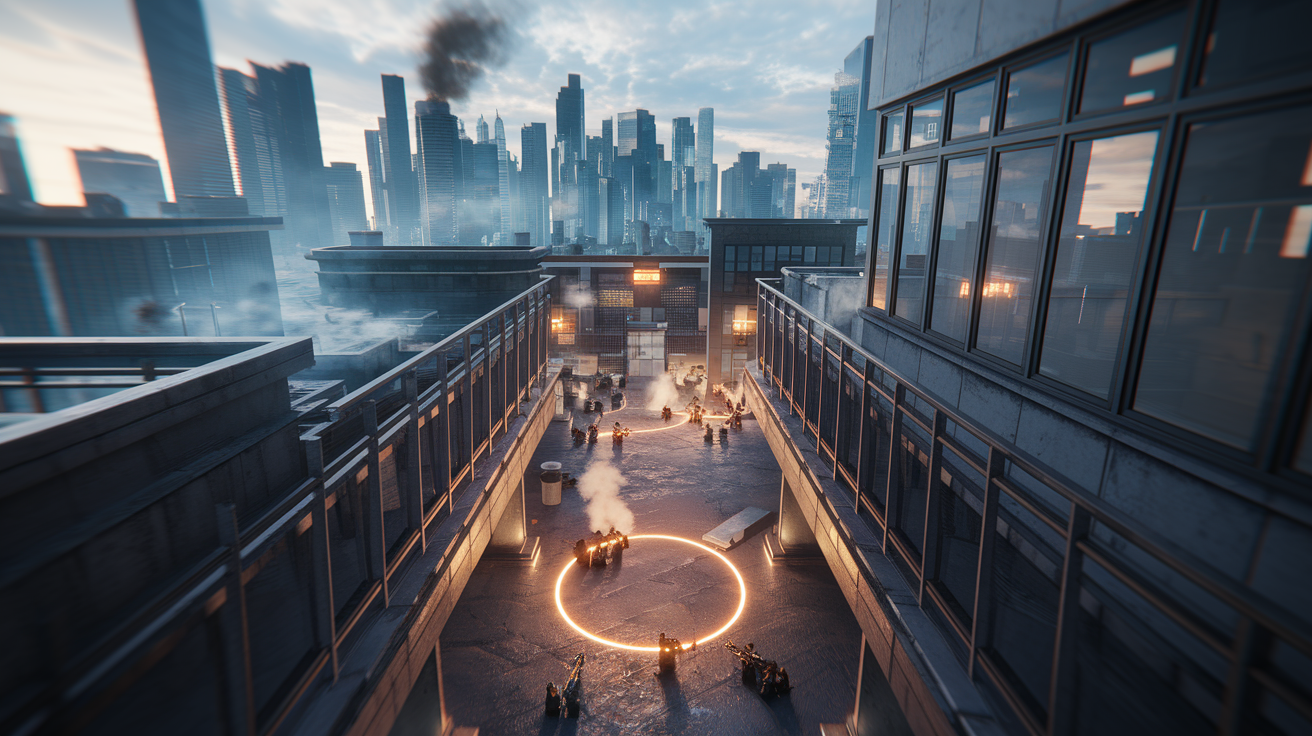
Competitive endgame strategy revolves around power position acquisition, height control, line-of-sight minimization, and zone anchoring. The fourth and fifth rings shrink fast and deal heavy damage, so positioning decisions made during rings three and four determine your placement ceiling. ALGS teams often pre-position two rings ahead, claiming central high ground or natural cover before most squads realize the value. Teams that wait until ring four to rotate get forced into bad angles, open ground, or contested entry points where they lose 50/50 coin-flip fights instead of controlling the pace.
Height advantage in final rings is worth about 1.5x the value of raw cover. A team on a rooftop, ridgeline, or platform can see enemy movements, control sightlines, and disengage vertically when pressured. Teams stuck on ground level have to react to information they can’t see and rotate through zones other teams are already watching. The exception is when height becomes a trap. If you’re on a roof with no escape route and the ring pulls away, you’re forced into a panic rotation under fire. Always evaluate two factors before taking height: can you hold it for at least 60 seconds, and do you have a mobility option (Valkyrie, Pathfinder zip, jump tower, or natural drop) to leave when the ring moves.
LOS minimization and zone anchoring are the final ring essentials. Minimizing line of sight means positioning behind natural cover (rocks, buildings, slopes) so only one or two enemy teams can shoot you at a time. Zone anchoring means holding a position inside the next predicted ring rather than on its edge, forcing other teams to rotate past or through you. When 10-plus squads are alive in ring four or five, the teams anchored in center have the lowest risk and highest control. Teams on the edge get forced into desperate rotations where they take damage from both the ring and enemy crossfire.
| Ring Stage | Priority Position Type | Risk Level |
|---|---|---|
| Ring 3 | Central high ground with 2+ exit options | Medium, contested but winnable |
| Ring 4 | Natural cover node inside predicted ring 5 | High, requires early rotate and hold |
| Ring 5 (early) | Zone-center anchor with LOS to 2–3 teams max | Very High, late rotates are suicide |
| Ring 5 (closing) | Mobile cover or legend-based hold (Gibby bubble, Caustic gas) | Extreme, positioning mistakes are instant death |
| Ring 6+ | Any cover with heal-off capability or Lifeline sustain | RNG-dependent, survival over kills |
Team Composition Synergy for Optimal Rotations

Legend selection defines your rotation ceiling. Mobility legends like Valkyrie, Horizon, Pathfinder, and Wraith unlock off-angle rotations that ground-only teams can’t access. Valkyrie’s ultimate lets your squad bypass chokes entirely, flying over contested zones and landing in power positions before other teams arrive. Horizon’s gravity lift enables fast vertical repositioning and can be used mid-fight to disengage or claim unexpected high ground. Pathfinder’s ziplines create permanent rotation infrastructure, letting your team move between buildings or cliffs repeatedly. Wraith’s portal offers clutch rescue plays when a teammate gets caught in the open or when you need to bail from a bad position without taking ring damage.
Controller and anchor legends like Caustic, Wattson, and Gibraltar shape where and how long you can hold positions. Caustic’s gas traps lock down chokes and buildings, forcing enemy squads to rotate around you or take heavy damage pushing through. Wattson’s fences and pylon provide stationary defense and ability denial, ideal for teams planning to anchor a single power position for multiple rings. Gibraltar’s dome and gun shield offer mobile cover, letting your team rotate through open ground or hold exposed positions longer than other compositions. Recon legends like Bloodhound, Seer, and Crypto increase ring-read accuracy and provide real-time information about enemy positions, which is essential for deciding when to rotate versus when to hold and let others move first.
4 High-Tier Team Composition Archetypes:
- Aggressive rotation: Valkyrie + Bloodhound + Bangalore. Mobility plus recon plus smoke cover for fast, unpredictable rotates
- Zone anchor: Gibraltar + Caustic + Lifeline. Mobile and stationary cover for locking down final ring positions and sustaining through extended holds
- Balanced control: Pathfinder + Seer + Wattson. Zipline rotations, real-time recon, and defensive hold capability
- ALGS standard: Valkyrie + Gibraltar + flex recon (Bloodhound/Seer). Global rotation tool, mobile cover, and information. Most versatile for all ring scenarios
Map-by-Map High-Tier Rotation Path Breakdowns
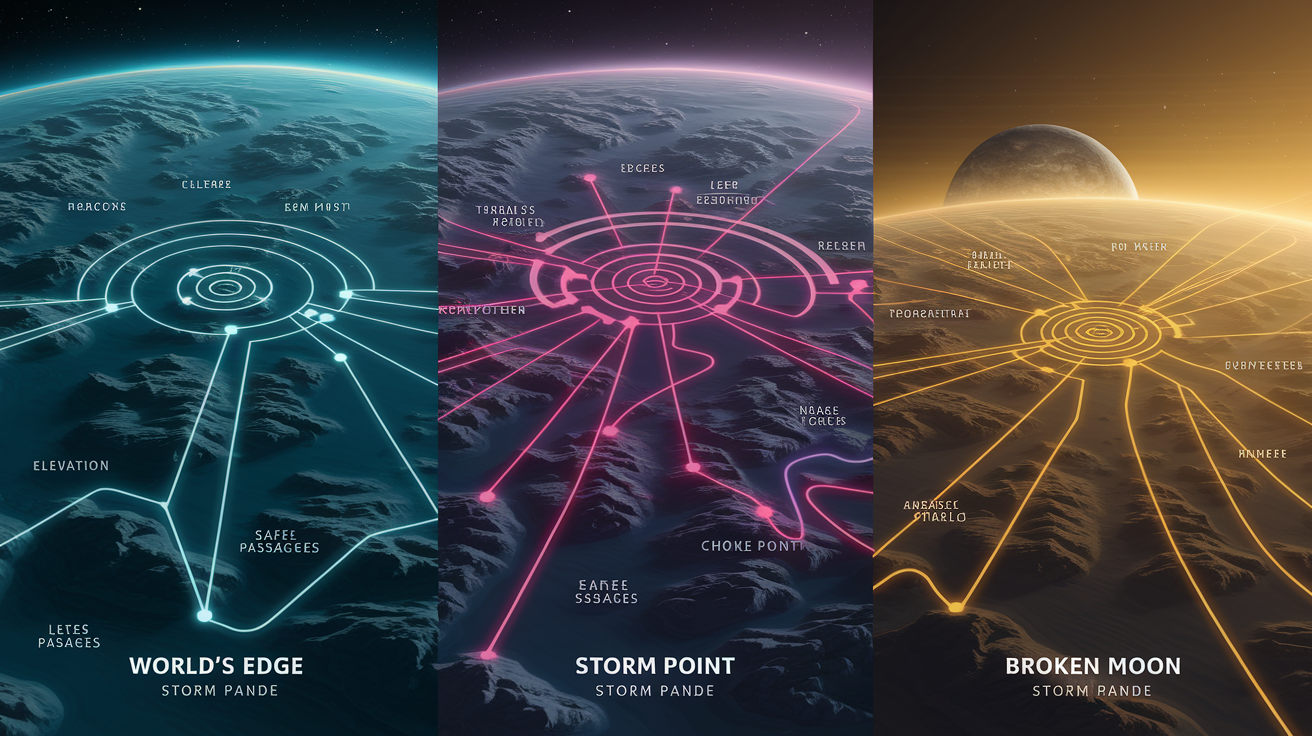
World’s Edge
World’s Edge rotations in 2025 prioritize avoiding Fragment chaos and using tunnel systems for covered movement. South-to-north lanes near Lava Siphon are stable but moderately contested. Teams rotating from Thermal Station or Tree frequently funnel through this corridor. The smartest rotates use the tunnel chain from Skyhook to Rain Tunnel to Mining Pass to Staging/Harvester, letting you move under cover and emerge near central POIs without crossing open sightlines. Fragment rotations stay high-risk because of vertical sightlines and the sheer number of squads that pass through or camp Monument/Stacks. Unless you have Valkyrie or a specific reason to claim Fragment high ground, routing around Fragment (via Overlook to Epicenter or via Countdown to Lava Siphon) is safer.
- High-value rotation: Thermal Station to west bypass past Tree to Lava Siphon. Avoids bridge gatekeepers and grants covered approach to central ring pulls
- Safe tunnel route: Skyhook to Rain Tunnel to Mining Pass to Harvester. Offers full cover and multiple exit points into mid-map POIs
- Aggressive skyward rotate: use balloons at Overlook or south of Thermal to cut 40 to 60 seconds off long rotations and land directly on contested POIs after early fights finish
Storm Point
Storm Point’s size and terrain make early rotations mandatory. Coastal rotations along the eastern and southern perimeter deter third parties because fewer teams path that direction and the terrain offers natural cover. Cascade Falls is a high-traffic rotation node. Timing’s critical. If you rotate through Cascade before the second ring closes, you’ll likely run into one to two other squads. Rotating after second ring closure forces you through a choke under ring pressure. Zeus Station sits in the northeast high ground and is a high-tier contest region for teams willing to fight early, but it offers excellent downhill rotations toward Command Center, The Mill, and Launch Pad. Using gravity cannons for mid-game rotations is essential. They cut transit time by 50% or more compared to on-foot movement.
- Safe coastal rotate: Fish Farms to Gale Station, pick up trident, ride west into central zones. Low contest, high mobility
- High-ground control path: Zeus Station to gravity cannon southeast toward Storm Catcher or Launch Pad. Downhill rotations are safer and faster than uphill pushes
- Cannon-chain rotate: Storm Catcher to gravity cannon east to spider camps to cannon north into mountains. Maximizes loot and speed while avoiding main roads
Broken Moon
Broken Moon’s vertical geometry rewards teams that claim high-ground tracks early. Promenade is high loot but chaotic. It attracts two to three squads per game and sits in a central bowl with limited escape routes. The safer play is landing on peripheral high-ground POIs like Grow Towers or the ridge north of Phase Driver, then rotating downhill toward Promenade after early fights conclude. High-ground rotation tracks along the map’s northern and eastern ridges offer cover, sightline control, and fast access to central power positions. The Phase Driver choke is one of the most dangerous rotation points on any map. If you must pass through it, do so before ring three or use a Valkyrie rotation to fly over entirely.
- High-ground perimeter rotate: Grow Towers to eastern ridge, rotate downhill toward Breaker Wharf or Production Yard. Safe, covered, and grants superior sightlines into central zones
- Avoid-choke alternate: Phase Driver choke can be bypassed by taking the northern mountain path or using ziplines west of Bionomics to swing wide around contested zones
- Promenade post-fight rotate: land peripheral (Stasis Array, Bionomics), loot fast, then push Promenade 60 to 90 seconds after drop when initial fights have thinned squads and loot boxes are available
Final Words
Land fast, loot hard, and watch the ring timer. Prioritize spots where sightlines and first-ring pulls favor safe grabs like Fragment, Zeus Station, or Promenade.
We covered landing philosophy, mid-game rotation timing, end-game zone anchoring, team comp roles, and map lanes for World’s Edge, Storm Point, and Broken Moon.
Apply the decision checklist and the map lanes recommended. Use Apex Legends high-tier rotation paths and hotdrop prioritization to pick fights you actually win. Play the timing, not the loot, and you’ll climb.
FAQ
Q: Who is the #1 Apex player right now?
A: The #1 Apex player right now changes frequently; check the official Apex Legends leaderboards or third‑party trackers for the current top player by platform and game mode—rankings update daily.
Q: Who all is LGBTQ in Apex Legends?
A: Apex Legends includes multiple LGBTQ characters; Respawn confirms identities through official bios and developer posts—check the game’s lore hub or recent patch notes for an up‑to‑date, canonical list.
Q: Is Apex capped at 300fps?
A: Apex has historically had a 300 fps cap on PC, but settings and updates can change that; check your in‑game Max FPS option or use launch options to adjust, hardware permitting.
Q: How often does Apex rotate ranked maps?
A: Apex rotates ranked maps on a scheduled cadence that usually updates weekly; Respawn publishes the exact rotation per season and for events—watch the ranked playlist or patch notes for current schedules.