


Skip the tutorial and you’ll burn an hour or more.
Do the right things first and you’ll save dozens of minutes and avoid dead ends.
This quick checklist tells you what to do in your first hour in Game.
Finish the tutorial, set controls and saves, and unlock fast travel.
Then find the starter merchant, grab free gear, and stock basic healing items.
Follow it and you’ll avoid the common early mistakes that force restarts.
Do These First in [game]: Quick‑Start Priority List

Here’s your first hour roadmap. Follow this before you wander off or chase side stuff.
- Finish the tutorial completely. Learn core combat, inventory, and map navigation in the first 15 to 60 minutes.
- Lock in your control settings. Adjust keybinds, sensitivity, camera FOV, and UI scale before your first real fight.
- Enable auto‑save and manual save slots. Set up save redundancy so you can recover from bad fights or wrong turns.
- Find and activate your first fast travel point. Unlock the nearest signpost, bench, or teleport anchor.
- Locate the starter merchant. Mark vendor locations on your map before spending currency on random loot.
- Complete the first main quest objective. This usually unlocks a zone, a crafting station, or a new merchant tier.
- Collect any free starter gear from NPCs or quest rewards. Equip it immediately, even if stats look low.
- Stock 10 to 20 basic healing items. Buy or craft basic potions before leaving the safe zone.
- Activate any early collectible tracking. Turn on map markers for chests, benches, or resource nodes.
- Set a manual save before your first boss or difficult encounter. Practice the fight without permanent consequences.
This order removes the most common early bottlenecks. Fast travel saves dozens of minutes across the first session. Merchants prevent wasted currency. Manual saves let you experiment without losing an hour of progress.
Players who skip tutorial mechanics or ignore the first merchant often restart within two hours. They miss a critical unlock or sell the wrong item and realize too late.
Beginner Builds and Starting Loadouts
Start with survivability, then add damage. Early builds should focus on one primary stat and two to three active abilities. Spreading points across multiple trees before level 15 makes you weaker than enemies at the same progression point.
If the game offers tank, healer, or DPS archetypes, pick one and commit. Tanks should allocate 60 to 80% of early points into defense, health, or armor stats. Use one crowd control skill and one taunt or threat generator. DPS players concentrate 70 to 90% into a single damage stat, pair one burst skill with one mobility or escape tool. Support roles stack 60 to 80% into mana, spirit, or healing power, then pick one heal, one cleanse, and one sustain passive.
Recommended starter priorities:
- Invest all early stat points into your archetype’s primary attribute. Strength for melee, intellect for magic, dexterity for ranged.
- Equip one defensive passive. Dodge boost, damage reduction, or health regeneration.
- Unlock one AOE or crowd control ability by level 5 to 8 to handle group fights.
- Keep one self heal or sustain consumable on your hotbar at all times.
- Avoid hybrid multi stat splits until you understand stat scaling and breakpoints, usually post level 20.
The biggest build mistake is point splashing. New players see three skill trees and assume they should sample all of them early. You end up mediocre at everything and strong at nothing. Enemies scale to expected power curves, so a diluted build hits breakpoints late and dies more often. Lock in one tree, max out two to three core skills, then branch out once you understand respec costs and late game synergy options.
Systems to Unlock Early

System unlocks control your progression speed more than raw level or gear. A player at level 10 with fast travel, inventory expansion, and crafting access will outpace a level 15 player who ignored those unlocks.
Priority unlock sequence:
- Fast travel or teleport network. Do this before exploring distant zones. It cuts travel time by 50 to 70% and lets you return to merchants or stash without losing progress.
- Inventory or stash expansion. Unlock this before hoarding rare loot. Missing bag space forces you to destroy or sell items you’ll need later.
- Skill tree and respec options. Confirm how respec works and what it costs. Some games lock respec behind a quest or charge increasing fees per reset.
- Crafting and upgrade stations. Access to crafting stations lets you create early game best in slot gear instead of gambling on random drops.
These systems act as force multipliers. Fast travel eliminates downtime. Inventory space lets you carry quest items, crafting mats, and backup gear without constant vendor trips. Skill trees with accessible respec options let you experiment safely. Crafting stations give deterministic upgrades when RNG fails you.
Players who delay these unlocks spend 30 to 50% more time on basic tasks and hit resource walls when they need quick upgrades.
Essential Items and Resources to Collect First

Early resources shape your upgrade velocity for the next 10 to 20 hours. Prioritize materials that unlock crafting recipes, expand carry capacity, or provide consistent healing during difficult fights.
Top priority items to collect immediately:
- Currency reserve of 100 to 500 units. Keep this buffer for repairs, respawn fees, and emergency vendor purchases.
- 20 to 100 common crafting materials. Leather, ore, herbs, or cloth depending on your game. These craft starter gear and consumables.
- 10 to 30 health potions and 5 to 10 mana or stamina potions. Stock these before attempting dungeons or boss fights.
- All available maps for your current zone. Maps reveal fast travel points, resource nodes, and hidden chests.
- Upgrade components like whetstones, enchanting dust, or equivalent. Collect enough to upgrade your primary weapon to +3 or +5 early.
- Quest specific collectibles flagged in your journal. Some games require 15 to 30 specific items for progression quests. Mark these early to avoid backtracking.
Crafting materials regenerate slowly or require exploration to farm. If you skip early gathering, you’ll hit a wall at the first major upgrade tier and need to backtrack through cleared zones. Health and mana potions prevent wasted respawns, especially when learning boss patterns. Maps unlock completion tracking and show hidden objectives you’d otherwise miss.
Players who ignore early resource collection often need to farm for two to four hours in mid game just to catch up on basic crafting unlocks.
Early Progression Milestones
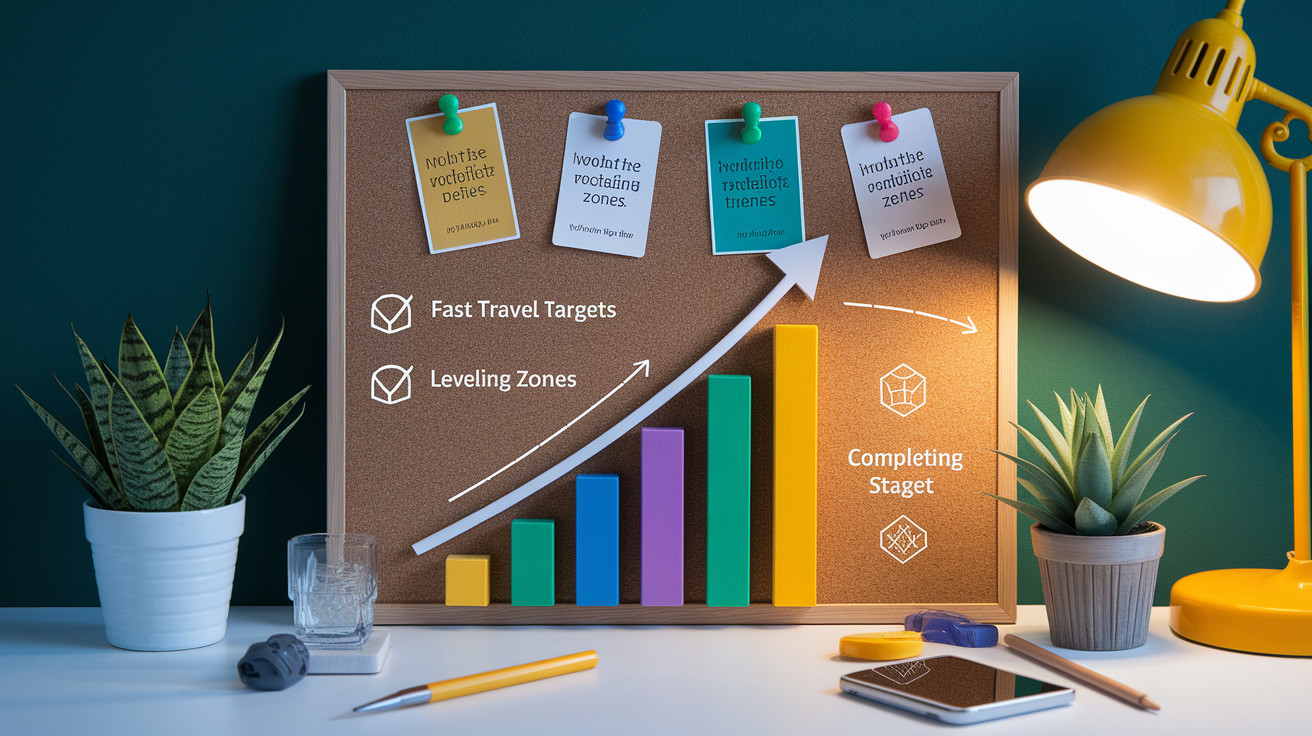
Milestones give you clear checkpoints and prevent aimless wandering. Use these targets to measure whether you’re progressing efficiently or stuck in low value loops.
| Milestone | Why It Matters |
|---|---|
| Unlock 3 to 5 fast travel points within first 2 to 4 hours | Reduces backtracking time by 50 to 70%, lets you return to vendors and quest hubs quickly |
| Reach level 6 to 12 or equivalent progression by end of first day | Puts you in range of first gear tier upgrades and mid tier skill unlocks |
| Complete 30 to 50% of starter zone locations and side quests | Ensures you didn’t skip critical unlocks or missable collectibles before moving to next region |
| Obtain and equip a full set of crafted or quest reward gear | Crafted sets provide consistent stats and prevent reliance on random drops during difficulty spikes |
These milestones act as forcing functions. If you hit level 10 but only have one fast travel point unlocked, you’re spending too much time walking and not enough time progressing systems. If you’re level 15 but wearing a mix of level 3 and level 8 gear, you skipped crafting or ignored upgrade stations.
Chasing these targets keeps your power curve smooth and prevents sudden difficulty walls when the game expects you to have unlocked core systems.
Common Beginner Mistakes and How to Avoid Them

New players lose the most time to a handful of repeated errors. Recognizing these patterns early saves hours of rework and frustration.
Top mistakes to avoid:
- Skipping the tutorial or rushing through tooltips. This costs 30 to 60 minutes later when you have to relearn mechanics under pressure. Finish the tutorial fully, even if it feels slow.
- Spreading skill points across three or more trees before level 20. You end up weaker than focused builds at the same level. Commit to one tree first, then diversify.
- Selling or destroying rare items without checking stats or affixes. Many games hide best in slot items in random loot. Mark rares for review before vendor trips.
- Ignoring fast travel and inventory unlocks. Delaying these increases grind time by 30 to 70%. Unlock them before chasing distant objectives.
- Refusing to use consumables or asking for help. Hoarding potions for later or avoiding group content wastes learning opportunities. Use consumables freely in your first 10 hours and join beginner groups within the first 24 hours of play.
Avoiding these mistakes keeps your progression smooth and resource efficient. Players who skip tutorials often restart after two to three hours when they realize they missed critical keybind or mechanic explanations. Point splashers hit their first difficulty spike and can’t respec affordably.
Hoarders who never use potions die more often and respawn more, which costs time and currency. The fix is simple. Follow tutorial prompts, focus your build, review loot carefully, prioritize system unlocks, and use your consumables when fights get difficult.
Final Words
In the action, your first hour follows a tight priority list: quick-start steps, a simple starter build, the earliest systems to unlock, the must-have resources, and the milestones that keep progress steady.
Follow the ordered steps to avoid common beginner mistakes, secure useful gear, and gain levels without wasting runs.
Keep this [game] beginner checklist what to do first as your go-to playbook for early sessions — use it, tweak it, and you’ll reach mid-game faster with less frustration.
FAQ
Q: What is the 80 20 rule in game development?
A: The 80/20 rule in game development says about 80% of player value comes from 20% of features, so focus first on core mechanics and polish high-impact systems to maximize fun and efficiency.
Q: What should we do before starting any game?
A: Before starting any game, set a clear first-hour goal, learn basic controls and the UI, tune settings (audio/performance), and choose a simple starter build or strategy to avoid wasted time.
Q: What is the 40 second rule in video games?
A: The 40 second rule in video games is a design guideline meaning players should get meaningful feedback or a small reward within roughly 40 seconds of interaction to keep engagement and momentum.
Q: What are the 7 steps of game development?
A: The seven steps of game development are concept, design, prototyping, production (art and code), testing, polishing, and launch with post-launch support and updates to fix issues and grow the audience.